Greetings to those who pass by here, haven't made a post in a while. I will be going back to making written posts until I am able to purchase a good video camera with which to make videos.
So, to kick off my long absence from sharing my reading adventures I start with Voltaire's Candide.
Recently, I have been getting more and more into philosophy and finding myself gravitating towards philosophical works, I'm halfway through Descartes's Metaphysical Mediations, which is considered the breakthrough in modern philosophy, and I'm highly enjoying it. Among other books, I ordered and received from bookmooch Voltaire's Candide which came with a few other stories as well. I haven't yet read the other stories but I did read Candide. Superficially, it is entertaining and full of adventure. The substance, as I'm sure many know, lies in the characters, their words and actions. Candide is the ultimate optimist trained philosophically by the philosopher Pangloss. Quickly in the story he finds himself thrown out of his comfort and henceforth encounters bizarre situation after bizarre situation. His foolishness leads him to willingly trust people yet his trust is continually broken and spurned, and the consequences are frequently unfavorable. Yet he remains undaunted. On a side note, I found it thought-provoking that there were numerous times when Candide would expound his virtuous hopefulness and "love" of mankind but he would follow that with an action that contradicted his philosophy of life. For example, when he followed his instincts and killed the characters he did, not many. It hinted at the weight of human nature, which is another theme that is touched upon in this story, what is evil?
In Candide, Voltaire was pushing against philosophical optimism and the "idealist" mentality of philosophizing as a "static" pastime. (I use the words idealist and static loosely). To Voltaire, philosophy involved the mind as much as the actions, and even though metaphysical ponderings are interesting the substance of life is found in our actions, hence the ending phrase that is emphasized, "cultivate your garden". It is interesting to compare Descartes and his meditations which stands on the other spectrum, where philosophy is an enterprise that should concern itself with the intangible, with the essence of "things".
To keep it short and sweet, I highly recommend this Candide to those that haven't read it, to those that have and it has been a while, another perusal wouldn't hurt. It's a good story with substantial substance.
Until next week.

Showing posts with label sin. Show all posts
Showing posts with label sin. Show all posts
Thursday, September 29, 2011


Friday, November 26, 2010
Pedro Páramo de Juan Rulfo
I have decided that Fridays are the designated days for posting. Having said that, I hope that everyone that celebrates Thanksgiving that passes through here and reads this has had a wonderful Thanksgiving with family and loved ones. Now to books.  I love Latin American literature, therefore I will be talking about a little book called Pedro Páramo
 . I say little because it is, roughly 150 pages. Yet what this book lacks in length it more than makes up for in genius.
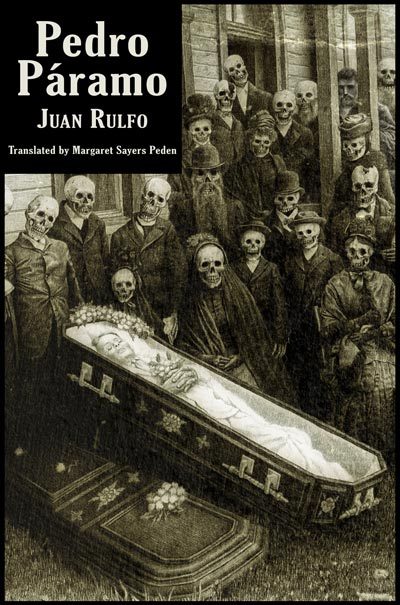 I love Latin American literature, therefore I will be talking about a little book called Pedro Páramo. I say little because it is, roughly 150 pages. Yet what this book lacks in length it more than makes up for in genius.
 First, the structure of the book, it is written through differing points of view, disjointed, the points of view and the characters speaking aren't clearly delineated. But don't let that daunt anyone, the voices are recognizable if one is truly concentrated on the vioce.
Second, this structure that at first is hard to assimilate allows for something, I find, magical to occur as one reads the book. With just the details and the characters given one gets a grander scope of the story. It's as if an encompassing novel is unfolding in just 150 pages.
The story follows a man that goes on a journey to Comala in Mexico, seeking to regain what belongs to him from the father he never knew. This is a promise he made to his mother on her deathbed. The juice of the story develops upon his arrival to Comala. Once there he finds the town deserted, a ghost town, haunted by the souls of those who did not have peace in life, the sinners, and those that where directly affected by the actions of the despot Pedro Páramo This is the man's father, Pedro Páramo, who was a tyrant that stole and gained at the cost of others.
As the man journeys through Comala, he begins to know his father, though he is dead, through the voices of the other characters.
This novel is, aside from many other things, rich in metaphors concerning man, his soul, sin and love. It is replete with beautiful imagery that allows for the story to develop like a work of art.
I highly recommend the book.
On a side note, the writer of this book, Juan Rulfo, wrote this one as his one and only standing masterpiece. Aside from this book, he has another one of short stories, El Llano en Llamas. I would have loved to have had more material to enjoy from this author, because I consider him truly amazing, but I understand while this is his only book, it is a work of perfection, there is no need to say more.
If anyone is interested in reading get and edition that has appendixes that go into depth explaining the story.
Thursday, October 7, 2010
파주(Paju)


Before I give and in-depth description of this movie I have to say first that I am reviewing and commenting on this movie as an outsider, having never been to Paju, South Korea.
Upon first watching this movie it struck me as vague, that was the "feeling" I had, and that "feeling" lasted weeks before I was able to fully digest and comprehend the movie as a whole. What helped me grasp the movie in its entirety was learning about 파주시 (Paju the city) and it's role in actuality. I will elaborate: Paju is located in the Gyeonggi-Do province of South Korea and it closely borders North Korea; add to this Paju is a DMZ(demilitarized zone). I think this fact added to the relationship of North and South Korea lead to the essence of the movie and the characters.
Take the lead male character, Kim Joong-sik (김중식), he is a man that from the beginning of the movie is lost, not in the literal sense but in a figurative "spiritual" way. From the very beginning his current relationship ends in an abrupt manner, leading him to move to Paju. There, he lives with a relative, who is a minister (leads people, has direction), and becomes a teacher. At this point in the movie the view and the story shifts to portray two sisters, one in high school, who are struggling to survive. The viewer meets and sympathizes with their situations and their struggles when the older one marries Kim Joong-sik who happens to be the younger sister's teacher. The plot thickens, so to speak, when the older sister dies and the younger sister blames her husband, the male lead.
All this we receive in bits, as the story is shaped as it goes back and forward in time. What is most touching in the story is the human struggles portrayed, the girl not being able to forgive her brother in law, the brother in law in love with the girl, the town struggling not to loose its home-the building that is threatened to be demolished. Also, this story has a lolita-esque side to it with the love and hate relationship between the main character.
The faults of this movie is its failure for creating a connection between Kim Joong-sik and the audience, it was hard for me to understand and sympathize his plight, plus the overall plot was lacking in a more concrete direction. Yet, now that I know Paju's role as a city, I perceive that is the effect the movie is trying to emanate to its viewers: the essence of the city's past and it's affect in the residents. Overall this was a vague (I use this word loosely) movie that left a big impact on me, plus the cinematography is beautiful.
To purchase:
YesAsia
Ebay
If you want to watch before the movie gets to you, go here: vikii
Here is the trailer:
Tuesday, October 5, 2010
Do you know Young Goodman Brown?

 , before this I had had no personal contact with Nathaniel Hawthorne. I only knew he wrote The Scarlett Letter, which I know is a popular book, since it is required reading in some high schools.
I must say my inexperience with Hawthorne slapped me in the face when I read this short story, I loved it. I perceived this story as an allegorical piece, resonating with truth, despair and human nature.
The action is set in Puritanical New England and it touches upon the themes of good vs. evil and its' role in human nature. The premise is: a man sets out on a journey at dusk, leaving his faithful wife behind, to go on an evil purpose.
To start of with the allegories in this story, first, the names given, the protagonist's wife, Faith, being his wife, tied to him with the strings of love, his love and his faith, stands as a symbol of faith and all the things in this world that are good and pure. She is the string that pulls the protagonist in one direction in the beginning yet after a decisive point becomes the antagonist. She represents the essence of what Mr. Brown is in danger of losing as he goes about his evil business.
Besides her representation, there exits the man that Mr. Brown meets on his journey through the woods. This man is not presented as sinister but as brooding, a learned traveler that resembles the protagonist. His resemblance signals his character in the protagonist's life, his active role in familiarizing himself with his prey and making himself seem relatable and harmless.
Then, onto the journey itself, the one Young Goodman Brown undertakes that stretches into the twilight hours of the night. This journey is life, the one that every human undertakes, walking through deep secluded woods, among dark paths, verdant and lush yet dark and sinister.
As the protagonist progresses in his journey he encounters doubts and truths that cause him to waver in many aspects: life, faith, sin, human nature. All this leaves him drained when he encounters what seem to be a "witch" gathering or what I'd prefer calling a gathering of sinners, of those who've strayed. In the midst of this, Young Goodman Brown comes to the conclusion of how he will lead his life, his perspective changes and his will is sealed. He undegoes a transformation that echoes for the rest of his days.
To end, I say that this short story by Nathaniel Hawthorme is vividly and masterfully written. If you haven't read it, do so.
"Say thy prayers, dear Faith, and go to bed at dusk, and no harm will come to thee."

Subscribe to:
Posts (Atom)
