Showing posts with label Books. Show all posts

Monday, January 7, 2013

The short and sweet of it

For those of you who frequently stumble upon this site and appreciate my minuscule input into the literary community, I have to confess that I almost abandoned it all. Good ol' life got obscenely in the way and I almost stopped talking of my literary escapades. But alas, 'tis not so, I am back again this year with somewhat new equipment and ready to take this to the level I wanted to in the beginning. And that is video-blogging. So, I will be making videos where I talk of literature and what I'm reading the current month. The manner will remain the same, every month different topics, only that now instead of tediously reading about what I'm reading, all y'all will be able to hear me talk about what I'm reading. YAY! Therefore, I hope those of you that come across this little baby of mine that is this site will be able to better enjoy my literary wanderings. This all begins in february. Till then!

P.S. I leave you with my youtube channel and the first few videos I attempted. 

Tuesday, April 17, 2012

Press: Great Expectations

A little while ago I made a post about how I was contacted by Xelsion Publishing to write an essay on Charles Dickens's Great Expectations. Well, I have completed the essay and here it is:

Bicentenary of Charles Dickens
I distinctly recall the first time I held Great Expectations in my hands. I stumbled upon the book by chance, in the sales bin, at a local bookstore. Recognizing the author from A Christmas Carol, I took advantage of the fortuitous chance and purchased the book. I started reading a couple days later. It began one night of restlessness, where sleep eluded me. I picked up the book and laid in bed, between the covers, and began to read the first page. In a matter of days I swallowed the book, wondering the entire time, "Where has this book been all this time, and why haven't I read it?" This was the beginning of a journey through Dickens’ world, a journey which led to falling in love with the authors’ voice, style and most markedly, his characters. I have always found that his characters seem to sit in the readers’ imagination as a dear old friend that one loves to revisit.

Singular and distinctly like Charles Dickens, Great Expectations offers a kaleidoscope of characters and of settings, with frank reality and a deft hand at writing. Portraying Victorian London and it’s surroundings, he lays bare this city for all to marvel, gape, gasp in horror, and fawn at, one feels almost as if one knows the city and is transported. Briefly, the story is about a boy who enters life with great expectations and matures into a man that sees the world for what it is, not necessarily with a pessimistic eye but with a sobering maturity. Along with the trajectory of this boy, from having little to having much more, there is also an underlying exploration of guilt, duty and what it means to be "good" and “bad” which laces the novel, ruminating behind the vivid scenes of the story. It is this exploration that engages the reader. Don't let this brief summary deter you, dear reader, from delving into Pip's story, for he is all of us. All the complex and disadvantageous traits that we as humans have, Pip has, and honestly, haven't we all had great expectations and found, later on, that life had other things to say concerning those expectations? On the ending, Charles Dickens wrote the book with two, the first ending was found to be too harsh and Dickens revised it to create a more pleasing, if not vague and somewhat hopeful, finale.

Charles Dickens
Source: http://www.charlesdickens.xelsion.com/about/
Like most of his books, this novel was first serialized, which gave an interesting dimension to the story unfolding before the eagerly awaiting reader. Now, what is special about this novel is not only the authors’ genius but that, unlike his other books, Great Expectations condenses everything for which Dickens stood. His signature preoccupations, motifs and
characters are tightly drawn, creating a story that doesn't sway, and drives its' point directly to the reader. This being said, this year happens to mark the bicentenary birth of this worthy author, and his novel, Great Expectations, is the perfect tapestry with which to begin delving into his talent.

Friday, April 13, 2012

Part One: The Master and Margarita

-What are you, then?  -I am part of that power that always wishes evil and always performs the good. -Goethe, Faust
Source: http://www.davno.ru/soviet-posters/propaganda/poster-12.html
Continuing with Bulgakov's The Master and Margarita. Part one of the novel opens up with Ivan the poet, called Homeless, discussing the veracity of the existence of Jesus. Berlioz, "chairman and editor of Moscow's largest literary journal" is asking that Ivan rewrite a poem so that it disqualifies the existence of Jesus. Immediately, Woland comes into the scene alone. This commences his entrance into Moscow along with his colorful entourage. Remember, faith and religion are not allowed in Moscow from early on in the 20th century, during Stalin's reign. The voice from the beginning is actively engaging and the chapters jump from one chaotic scene to the next as Woland and his retinue challenge and disorder the inhabitants of Moscow. Disappearances occur, which very much aligns with what was in reality happening during Bulgakov's time. If a person was found to be a hinderance on the government and its' aims, said person would "disappear". Intertwined with this present Moscow (1920's) is the retelling of Jesus's judgement in Judea but, as opposed to the New Testament perspective, from the point of view and interpretation of Pontius Pilate.

This double outline illustrated from the beginning reveals a constant interplay of beliefs which evolves within the story. Which brings to the forefront, what is truth? What is faith? Faith is suggested as a mental illness. The supernatural is also intermixed with these questions, as Woland continues to suspend the readers' and the characters' belief by means of his and his retinue's magic and trickery. Many of the characters introduced are arrested, sent to a mental hospital, transported mysteriously somewhere far, or just disappear.
"if there is no God, then may I ask who governs man's existence and all world order?"[...]"In order to govern, one needs to have a definite plan for some reasonable length of time. Allow me to ask you how man can govern anything considering that not only is he unable to plan for even a laughably short period, say a thousand years, but that he cannot even vouch for tomorrow?" -Woland
Source:
 http://www.davno.ru/soviet-posters/propaganda/poster-12.html
Woland, whom the reader, a few chapters in, can identify as the devil is also painted differently. Contrary to the preconceived concept of whom the devil is and his ruthless maleficence, this devil challenges disbelief and lacks ruthlessness, for even though a few characters do loose their lives, one is lead to see the reason behind that loss and what led to it.

Following the first chapter, Ivan Homeless is entered into a mental hospital, where he meets the Master. He is the creator and writer of the story of Pontius Pilate, it is his book banned and his writing career truncated due to the subject matter of his book, the retelling of Jesus' judgement from the view of Pilate, the judge. What struck me, among many other things in this excellent novel, is how faith, pre-notions and traditions are questioned. Jesus is not portrayed as divine either, merely as a humble rabble rouser, and vice versa, the devil is not entirely evil according to orthodox conviction.

Part one, rather than highlight one specific protagonist, sets the plot which leads to the second part and the introduction of Margarita. The action is quick and precise, and the writer is in continual sporadic conversation with the reader throughout, which in turn engages the attention.
"What other oddities transpired in Moscow that night we know not, and we certainly will not pry, especially since it is time for us to move on to the second part of this truthful narrative. Follow me, reader!"

Monday, April 9, 2012

Charles Dickens Project

Just a brief side note. I am a big Charles Dickens fan. His flare, style and colorful portrayal of humanity and of life, specifically in London, is enticing to me. Well, last year I reviewed one of my favorite Dickens book, Great Expectations, in a video. This year commemorates the 200th anniversary of his birth, 7th February 1812, hence the creation of projects celebrating this master storyteller, one in particular is the Charles Dickens Project by Xelsion Publishing. Their aim is
"to bring back the unique thrill of seeing a story take shape before your eyes, taking it one step further by combining it with the kind of revealing, honest and real-time traffic between author and reader that the instant feedback of modern social networks allows."
Well, they contacted me to write a brief article on Charles Dickens, which they will be posting shortly, and I was, of course, very much obliged and grateful. So, I'm taking this brief time and space to share this excellent project with all the readers out there that happen to stumble or follow my blog. The serialization of Great Expectations is available to download for the kindle or you can just read the chapters right from the web. Stop by the site, you might find yourself following and enjoying Great Expectaions.
Dickens and his characters.
Source: http://www.charlesdickens.xelsion.com/dickens-resources/

Links:
David Perdue's Charles Dickens
Dickens 2012
Charles Dickens Museum
A Dickensian

Thursday, February 23, 2012

Two Nights of Excess

Following up with last week's post on Michel Onfray, my last visit to the city of New York turned up a little small book by a french author, Alfred de Musset. A renown poet, playwright and novelist of the Romantic period, this little book I stumbled upon was his try at erotic literature, Gamiani, Or Two Nights of Excess. According to the sources I've found on the book, the character of Gamiani is modeled after George Sand, another french writer, this is also said in the introduction of the book.
I found, after reading this little 100 or so page book, that in regards to the sexual aspect, it was comprehensive, covering everything from orgies, sacrilegious or otherwise, sadomasochism, bestiality, voyeurism, etc. No major perversions are neglected in the book. Much of it reminded me of the Marquis de Sade, on referring to him I highly recommend the excellent movie, Quills. This book incorporated much of the libertine spirit with a heightened element of the extreme, all for the sake of la petite mort. What distinguished this book from other erotica is its' lack of phallocentricity. The dominant character and sex is Gamiani, a woman.
On the the novel itself, it centers around two nights, between Gamiani, the Italian seductress, Fanny, the innocent virgin, and M. Alcide, the voyeur. The three meet on a night Gamiani holds a ball, the guests leave, she has lured Fanny into her room and Alcide is watching from a hidden place. No crevice is left untouched in their encounters. These three characters indulge extensively in themselves.
A brief interlude occurs during these two nights, where, the hunger of the characters is momentarily satiated and each partake in recounting their first sexual encounters. These are the moments that struck me the most, since it is in these tales recounted that one is able to see the imbalance created by the preceptors of youth, such as family members, and culture, and the predominant stigmatization of religion in regards to sexuality. Each of the characters have suffered at the hands of these stigmas, This imbalance is revealed in extremes that hinder and warp the natural, biological elements and desires that make up a person. This consequently, brought to mind Michel Onfray and his excellent treatise, Théorie du Corps Amoureux: Pour une Érotique Solaire. Which highlights the importance of letting go of the warped views of sensual relations, hindered mostly by extreme religious notions, hatred towards oneself, as well as by idealized romantic views.
If anything else, besides being an erotic novelette, Alfred de Musset in this book reveals diverse facets of human sexuality, how it is susceptible to dangerous extremes, much along the lines with the Marquis de Sade, although Musset draws a more poetic stroke with his words.
So, in the end, I recommend this book to those looking for interesting erotica. I enjoyed it.

Tuesday, October 18, 2011

El hombre que inventó Manhattan

I finally finished Ray Loriga's "El hombre que inventó Manhattan"
and let me just say that I loved every word of it. I still stand by what I said in my earlier post, on my first impressions of the book. This is a colorful and deliciously sordid tapestry of stories that combine to give life to a city that is at once famously elusive and enticing. Beyond its' relation to the City of New York, specifically the borough of Manhattan, I find that the entire book transcends its' title and this territory in that in general and concise words it paints for the reader the diversity found in human nature especially bred in a large mass of population coexisting in a tight space. We are all related and connected, man and nature. This was most evident when I found the chapter on the rat Missy, describing it's first adventure into central park, being a young rat. Which connects to the ending entitled, "De Ratones y Hombres", where this same rat is killed by the narrator, before his sons' eyes whom had just named it Missy.  Curiously enough, this immediately brought to mind lines by the scottish poet of the Romantic period in English literature Robert Burns, "The best laid schemes o' Mice an' Men, Gang aft agley, An' lea'e us nought but grief an' pain, For promis'd joy!" (Lines 39-42). This is from his poem "To a Mouse". There is an interesting correlation between these two different works that I find relevant and important in understanding the core of what Ray Loriga presents in this book. Besides a description of the human condition found in a city as diverse and populated as NYC it is also a testament of man at his most grotesque and real and the harsh reality of human nature.

Now, I have begun and am about 15 pages in in the philosophical book I said in my previous post I was to begin next, Théorie du Corps Amoureux: Pour une érotique solaire by Michel Onfray. So far, I love what the book proposes to discuss and analyze in the opening pages. Briefly and roughly, it proposes individual autonomy and freedom from the bounds of oppressive western cultural traditions retaking and reinstating the Greek philosophers.

Till next post...

Friday, November 26, 2010

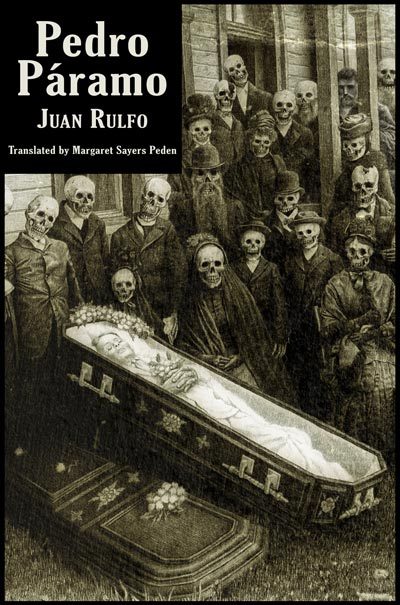
Pedro Páramo de Juan Rulfo

I have decided that Fridays are the designated days for posting. Having said that, I hope that everyone that celebrates Thanksgiving that passes through here and reads this has had a wonderful Thanksgiving with family and loved ones. Now to books. 
I love Latin American literature, therefore I will be talking about a little book called Pedro Páramo. I say little because it is, roughly 150 pages. Yet what this book lacks in length it more than makes up for in genius. 
First, the structure of the book, it is written through differing points of view, disjointed, the points of view and the characters speaking aren't clearly delineated. But don't let that daunt anyone, the voices are recognizable if one is truly concentrated on the vioce. 
Second, this structure that at first is hard to assimilate allows for something, I find, magical to occur as one reads the book. With just the details and the characters given one gets a grander scope of the story. It's as if an encompassing novel is unfolding in just 150 pages. 
The story follows a man that goes on a journey to Comala in Mexico, seeking to regain what belongs to him from the father he never knew. This is a promise he made to his mother on her deathbed. The juice of the story develops upon his arrival to Comala. Once there he finds the town deserted, a ghost town, haunted by the souls of those who did not have peace in life, the sinners, and those that where directly affected by the actions of the despot Pedro Páramo This is the man's father, Pedro Páramo, who was a tyrant that stole and gained at the cost of others. 
As the man journeys through Comala, he begins to know his father, though he is dead, through the voices of the other characters. 
This novel is, aside from many other things, rich in metaphors concerning man, his soul, sin and love. It is replete with beautiful imagery that allows for the story to develop like a work of art. 
I highly recommend the book.
On a side note, the writer of this book, Juan Rulfo, wrote this one as his one and only standing masterpiece. Aside from this book, he has another one of short stories, El Llano en Llamas. I would have loved to have had more material to enjoy from this author, because I consider him truly amazing, but I understand while this is his only book, it is a work of perfection, there is no need to say more. 
If anyone is interested in reading get and edition that has appendixes that go into depth explaining the story.


Friday, November 5, 2010

Currently reading

After having finished Brave New World it took me a little longer than usual to find a replacement. I looked around my library and nothing caught my eye. And for some reason unbeknownst to me I felt compelled to read Great Expectations again, Charles Dickens being one of my favorite writers. 

Yet, today as I was getting ready to leave the house I suddenly remembered a book I had bought in a used bookstore during my stay in New York  City. I was aware that the author, Wilkie Collins, was a contemporary of Mr. Dickens but I was somewhat reluctant to pick it up.

In the end I went against my original desire and began reading The Woman in White by Wilkie Collins and I must say, I find it very engaging. 

To start off, it is a mystery/suspense story and according to an accompanying synopsis, a very popular novel in its' time, the 19th century. So much so that Wilkie Collins' tombstone is inscribed with "author of The Woman in White..."

So far so good, I'll post the review once I'm finished. 

Monday, November 1, 2010

~Community, Identity, Stability~

Continuation...
Another post is due for Brave New World because I find this book containing such rich metaphors that it is a rip fertile ground to harvest.

To start with one, take all the characters in the book. I found it very interesting that none of the characters were definitively heroic, neither perfect nor entirely likable.

First, the Savage is the "hero" of the story but as the story progresses he is not completely heroic. His act of heroism lies in resisting the "masses" and sticking to his beliefs, choosing a life of imperfection, hence discomfort and unhappiness. This is what sets him apart. Yet he is unrestrained, rash, violent and towards the end turns into an extremist, going through great lengths to set himself apart from the world.

And there's Bernard Marx, he starts off as the one most disconnected to the capitalist mentality and society. He is attune to his emotions, not fearing solitude and preferring to go against conventions. Yet, once he brings the Savage back and his presence gives him popularity, he changes. Marx becomes a prideful buffoon salivating in the limelight the Savage brings him, the attention he now gets from the ladies that before ignored him and found him weird, the inclusion and acceptance as part of society, whom before relegated him to the sidelines. This drastic change brings about the revealing of his imperfections and his nature: just a man longing to be accepted.

Then there is the writer, HELMHOLTZ WATSON . His role in the story plays a dual part, one of giving the reader a glimpse of the yearnings of a writer and portraying the importance of solitude, innovation and the breaking from convention that is necessary to indulge in the art that is writing. His is a character that proposes and confirms that idea that writing is an act that cannot be streamlined by the media, by society nor by the governing rulers and their ideals. Writing is a task entirely apart from all those aspects of life. It is an act of disengaging oneself from the surroundings and revealing the connotative that therein lies.

These three main men, all play an interactive and integral role in humanizing the story told to us readers in this book and further concretizes the ideas herein presented. This books isn't so much an intricate plot driven story but a work meant to expose specific and intricate ideas in a tangible manner.

There is a surplus of ideas and concepts that can be explored in this book but I leave that for the readers to explore in their own time as they read Brave New World and reflect on its' connotations.

In-depth, links:
one
two
three

Saturday, October 30, 2010

Brave New World: "Community, Identity, Stability"

I finished Aldous Huxley's A Brave New World and what can I say...
I had heard many reviews of this book before reading it, some good, some so-so and others not so. But this book is amazing. I found it replete with allusions, allegories, metaphors and wonders.

This book presents the reader with a futuristic world, where the capitalistic mentality has seeped into every fabric and layer of life. It is a world centered on the utopia ideal, which in turn becomes a dystopia. This concept raises several interesting rhetorical questions: can man create a perfect society? What are the limits of human development? How much is too much in the structure of society? What is happiness?etc.

The book opens describing and explaining a human hatchery, where humans are created. And they are consequently reared and shaped through hypnopædic lessons and training that indoctrinates children from infancy upwards. In these drills children are disciplined according to a caste system that delineates the job and future of each human being.

Sexual pleasure is reduced to its most basic form, love does not exist, neither does passion. The arts are non-existent, books are unheard of, except reference books for logical reasons, and individualistic ideas are absent. This is a society where movies are in the form of porno graphical propaganda that advances the ideal of like-mindedness, there is no individual thought, and seeks to satisfy the most basic of sexual needs. In this society, there is no time for solitude, "everyone belongs to everyone else," and happiness lies in social stability as a whole. "The world's stable now. People are happy: they get what they want, and they never want what they can't get. They're well off; they're safe; they're never ill' they're not afraid of death; they're blissfully ignorant of passion and old age' they're plagued with no mothers or fathers they're got no wives or children, or lovers to feel strongly about; they're so conditioned that they practically can't help behaving as they ought to behave." And there's also soma, a pill rationed out every day, after work, that functions somewhat like prozac in its' essence. All these tools accumulate to veil the population to the facets of life that we are currently accustomed to. And there is no God, no belief in any deity, no life after death, no transcendental thought. There is no dirt, "ending is better than mending", cleanliness is next to godliness and the capitalistic model underpins thoughts and actions. Violent Passion Surrogate releases the human need for precisely that: violence and passion. Everything is clearly delineated and classified, surprises are not part of the social organization.

This books is not without its minor defects but as one whole, it is a masterpiece that has surpassed the deterioration of time.

Here, the last part of the final, most important conversation in the book between the Controller (Head Governor) and the Savage (who wasn't raised in this structure):
"But I like inconveniences." -Savage
"We don't, we prefer to do things comfortably."
"But I don't want comfort. I want God, I want poetry, I want real danger, I want freedom, I want goodness. I want sin."
"In fact you're claiming the right to be unhappy."

In the end, I highly recommend this jewel of a book, it will awaken thoughts and ideas that might have been dormant.

Here are helpful links that gives background information on the book: http://foothilltech.org/rgeib/english/bnw/

Thursday, October 21, 2010

The magic of books

“The books are to remind us what asses and fools we are. They’re Caesar’s praetorian guard, whispering as the parade roars down the avenue, ‘Remember, Caesar, thou art mortal.’ Most of us can’t rush around, talk to everyone, know all the cities of the world, we haven’t time, money or that many friends. The things you’re looking for, Montag, are in the world, but the only way the average chap will ever see ninety-nine per cent of them is in a book. Don’t ask for guarantees. And don’t look to be saved in any one thing, person, machine, or library. Do your own bit of saving, and if you drown, at least die knowing you were headed for shore.”
—
Ray Bradbury, Fahrenheit 451

Found this floating around tumblr and thought it was so amazing that I decided to put it on my blog.


Follow the rabbit trail...