Showing posts with label Julio Cortázar. Show all posts

Monday, March 26, 2012

Graffiti de Julio Cortázar.

"Tantas cosas que empiezan y acaso acaban como un juego..."
Cada vez que leo un cuento nuevo de Julio Cortázar me confronta el talento brillante de este escritor Argentino y siempre aprendo algo relevante y nuevo. Esta semana vengo con su cuento Graffiti, es uno de sus cuentos populares, y además, soy una empedernida seguidora del movimiento de arte urbano/graffiti.
Antoni Tàpies
http://www.galleristny.com/2012/02/painter-antoni-tapies-dies-88/
Este cuento de Cortázar se trata de un artista de graffiti, durante unos tiempos turbulentos en su país, el cual no se divulga. Estos tiempo son de gran prohibición, y por consecuente, de reprimir al pueblo, de miedo y de abuso del estado contra el pueblo. Por extensión, el graffiti de cualquier forma no es permitido. Este artista, un día inesperado, se topa con otro artista, el cual el denomina como ella, deduciendo su sexo sólo por la "esencia", el trazo de sus lineas en su dibujos y los colores que utiliza. Siguiendo este encuentro, los dos comienzan una relación ficticia y a la vez real en la que los dos se siguen mediante el arte que plasman al azar por la ciudad.  Este juego que emprenden se convierte en un reto y un afán, en el cual los dos luchan por encontrarse. Pero, sucede que mientras ella le respondía a él con un dibujo los policías la atrapan. El llega tarde a la escena, sólo logrando ver como se la llevan arrestada. De ahí, el artista cae en una melancolía, a la vez sintiéndose culpable y triste por lo que le sucedió a ella. Luego de varios meses sin pintar, el sale a la calle y plasma una imagen sobre la pared de un garage. Esperando después el día entero para ver si habían borrado su graffiti, como siempre hace sin tardía, la policia. Pasado el día, al llegar la noche el se acerca discretamente a su dibujo y ve en una esquina diminuta un dibujo que no es suyo, el cual el toma como respuesta de ella.
De primera impresión este cuento es simple, pero, como suele pasar con los cuentos buenos, hay más escondido detrás de las palabras.
Éste es un grito de esperanza, una búsqueda de sosiego y un reclamo de libre expresión. El protagonista se desahoga, plasmando para la vista de todos, mediante su arte. Salir a pintar tarde en la noche, capaz de ser arrestado, y pintar sobre una pared libre de color e idea es un reto de confrontar el miedo y así domándolo. El reto lo toma el artista como forma de mantener su esperanza viva y para compartir esta esperanza con el pueblo, los cuales también sienten el mismo miedo y la misma melancolía de vivir en un país que acapara la libertad individual. Al indagar sobre la dedicación del cuento, A Antoni Tàpies, descubro que éste fue un artista durante los tiempos de Franco en España. Su arte es clasificado como doblemente modernista y post-modernista, y se interesaba por interpretar aquello que abarcaba la esfera social y publica, la libre expresión y así despertando la consciencia del espectador.  Tàpies vivió en Barcelona y murió hace unos años atrás a los 88 años. Conociendo esta información permite una mejor interpretación del cuento, dedicado a este artista español famoso e iconoclasta. Es un llamado al arte por el amor al arte como medio que debe estar modulado por la libre expresión. La próxima vez que estés vagando por la ciudad y te topes con arte urbano/graffiti, detente y mira bien, puede que te esté diciendo más de lo que percibes a simple vista.

Every time I read a new short story by Julio Cortázar I am astounded at his amazing talent that reveals imperceptible truths. This time it is his story Graffiti, it is one of his popular short stories.
It is about a graffiti artist that resides in an extremely prohibitive city, where freedom of expression is severely punished and where abuse of the police against the citizens abounds. This artist, as a way of rebelling, does graffiti, painting diverse images around the city. One day, he finds there is another artist like him that is following his trail, painting images next to his as a means of communication. This unknown artist he denominates as female by the subtle feminine nuances he perceives in the images. Following this encounter, both strive feverishly to stumble upon the other, a yearning for contact and understanding. Unfortunately, while she was responding with a graffiti to one of his, she is arrested by the police. The protagonist then falls into a melancholic stupor which he spends drinking and avoiding painting. A few months pass and he gathers the courage to go out and graffiti. He does so. That day, he spends his time discretely going back to the painting, wanting to see if it has been erased. Towards nighttime, he goes to check his painting and finds a minuscule drawing on the side of his work, which he interprets as a response from her.
Upon first impression this short story is simple but, like every good story, there is depth behind it's words.
This is a story about the freedom of expression, of art being unencumbered by state or outside influences and of the desire of unity and hope. The artist, in going out and painting, faces the fear that suppresses the masses that surround him, his art is a form of courage.
Les quatres cróniques, 1990. Fotograph: Jordi Bedmar
http://www.fundaciotapies.org/site/spip.php?rubrique865
Digging even further and investigating the dedication of the story, To Antoni Tàpies, I discovered that Tàpies is a spanish artist that lived during the time of Franco, in Spain. He died a few years ago at the age of 88. His art is considered both modernist and post-modernist, that sought to "transform the public's conscience" concerning social and public matters. It was as well, a a bastion for freedom of expression. Knowing this information allows the reader to better interpret Cortázar's "Graffiti", dedicated to this iconoclastic and famous spanish artist. It is an appeal to art for the love of art and as a medium that should be modulated by freedom of expression. The next time you, reader, find yourself confronted with a graffiti/urban art, stop and look well, it might be saying more than is easily perceptible.

Links:
Fundació Tàpies
Graffiti

Friday, March 16, 2012

Historias Que Me Cuento de Julio Cortázar

Un hombre tiene que tener sus lujos secretos, sus callados despilfarros, cosas que otros aprovecharían hasta la última migaja.
Comienza éste cuento, "Historias Que Me Cuento", con un narrador soñador, apto para crear cuentos, los cuales se cuenta en la oscuridad de la noche antes de dormir. A veces al lado de su mujer y muchas veces solo. Tanto así, que estos mismos cuentos se vuelven sus sueños. De aquí el narrador parte para explicar cómo elabora sus cuentos, en ellos él es en muchas ocasiones un camionero, aventurero, atravesando "montañas y rutas que daban miedo". En estas historias que crea, llenas de lo inesperado y lo esperado, el protagonista comúnmente se topa con mujeres que recoge en el camino. Viajantes solitarias que necesitan la ayuda de un camionero que las cobije de los terrores de la noche. Es en una de estas historias con la que el narrador se encuentra con Dilia, "la noche vacía y una interminable espera al borde de la ruta en la que cada pájaro nocturno era una amenaza", ella en la soledad de la penumbra al pie de unas rocas. Sucede lo esperado, conversación, beber, comer, descanso y luego sexo. Lo inesperado en todo momento es que Dilia es la que está en este sueño, no una desconocida sino una conocida y casada.

El sexo que transcurre entre ellos dos, el camionero y Dilia esta lleno de ternura y de longevidad, no de lo furtivo de la noche que suele popular el coito con el que se topa frecuentemente el camionero. Habiendo saciado su deseo, el narrador despierta del sueño para confrontar a su pareja, y con ella lo cotidiano. El se detiene pero no le cuenta el sueño a su pareja, y el día prosigue como debido.

Meses después, se reúnen las dos parejas, El y Niágara, Alfonso y Dilia. En esa noche comparten la muerte de la madre de Dilia, luego risas, bromas y coñac. En un momento, Dilia cuenta como ella se quedó extraviada y necesitada de ayuda durante ese tiempo en que viajaba a ver a su madre en sus últimos días de vida. Un camionero paró y la recogió. Este relato que ella comparte tiene dos partes, ella sólo comparte la primera con los otros. Ya tarde en la noche y bien curados con el coñac, el bebé de Dilia llora y ella corre a su lado. Aparte, mientras Alfonso y Niágara conversan y continúan bebiendo, el narrador se aparta y se dirige hacia Dilia, que le cambia el pañal a su bebé. En este instante es la tensión protagonista. El narrador la mira y ella se voltea y se miran a los ojos. El le confiesa que conoce la segunda parte de su relato, que ella se acostó con el camionero.

Ya expuesto en palabras reducidas el cuento, ahora hablaré sobre las maravillas de Julio Cortázar, como él entrelaza la realidad y la fantasía en un cuento. El juego de palabras con el cual tiende sus historias. ¿Cuál será la verdad de éste cuento? ¿Habrá sucedido de verdad el sueño del camionero? ¿Serán ellos dos, Dilia y el narrador, amantes?

En este cuento se ve claramente plasmado el deseo y lo maternal entrelazados y además, una melancolía permea cada imagen dibujada por las palabras de Cortázar. Es como si lamentara esos deseos y hasta posibles amores que no pueden llegar a florecer por circunstancias externas concretas.

This short story by Julio Cortázar, "Historias Que Me Cuento", features a dreamer for a narrator, one who weaves stories before going to sleep in order to expatriate himself from the tangible routine of daily life. These stories he creates often transform themsleves into dreams that populate his sleep. It recurs that in these dreams he is a trucker, enamored with the idea of freedom in the open road, the unexpected and the new. It so happens that in one of these stories he stumbles unexpectedly with Dilia, a woman he knows, stranded and alone at the mercy of the night. This he finds odd and surprising because the women he normally picks up in these creations of his mind are always unknown. As accustomed, he picks her up and rescues her from the rocky and solitary night. The expected occurs, conversation, drink, eat and sex. Yet, the union they share is not tainted with the customary furtiveness and insignificance that permeates his past encounters. This one holds a tenderness and longevity the narrator did not expect. Later, they sleep and he awakes to be confronted with his real and tangible woman, Niágara.

Months later, both couples, Niágara and the narrator, Alfonso and Dilia, meet for dinner and an evening of amiability. They eat, drink and share jokes over cognac. Further on in the night, Dilia retells an event that occurred to her on one of her visits to her mother during her last days of life. She was stranded, late in the night, and a trucker stopped and picked her up, rescuing her. This story had two parts, she only retold the first part to the others when her baby began crying from another room. She immediately went to the baby. The narrator finds his chance and leaves Alfonso and Niágara conversing. This is the moment when the tension seeps throughout the scene. The narrator approaches Dilia, she turns, and they both look each other in the eye and he tells her that he know the second part to her story, she slept with the trucker.

Now, what I find enchanting about this short story is the melancholy that pervades throughout the images created by Cortázar. In many ways, it's a quiet lament for impossible desires and even loves that are not able to flourish due to external concrete circumstances. All this, the maternal and desire interweaving, is once again exposed through Cortázar's excellent ability to intermingle reality with fantasy. His talent for warping time, space, the real and fantasy is latent in his sentences.

Wednesday, March 7, 2012

Recortes de Prensa de Julio Cortázar

"Aunque no creo necesario decirlo, el primer recorte es real y el segundo imaginario."
Yo tengo un pequeño compendio de cuentos de Julio Cortázar, Queremos Tanto a Glenda. He ido leyendo los cuentos poco a poco, siendo Cortázar un cuentista detallado y excelente, sus historias se merecen varias lecturas despacio.
En fin, siendo Marzo el mes que he escogido para dedicarle a Cortázar, comenzaré con su cuento, "Recortes de Prensa". Lo he leído ya varias veces para poder captar sus matices. Toma lugar en París. Un escultor invita a una escritora, ambos argentinos y amigos, para mostrarle sus esculturas nuevas. Luego de mostrárselas le pide que haga una escritura que las acompañe. El tema de las esculturas es la violencia y sus múltiples caras.
"Incluso la tortura, esa forma última en que la  violencia se cumple en el horror de la inmovilidad y el aislamiento."
Partiendo de aquí, la escritora le muestra al escultor, sobre una taza de café, unos recortes de prensa. En éstos recortes se relatan unos secuestros ocurridos en Argentina durante 1975-80, la Guerra Sucia de Argentina. Al leer estos recortes, las obras del escultor se ponen en perspectiva y se cuestiona de manera indirecta, ¿qué función tiene el arte ante las atrocidades reales que ocurren diariamente?
Luego de una conversación en la que se debate el tema del arte ante la sociedad, la escritora se retira a su casa. En el camino, ya tarde en la noche, ocurre una transición, un desdoblamiento de tiempo y espacio en el que ella se encuentra ante una escena de violencia doméstica, específicamente de tortura. El hilo se rompe y ella regresa a su hogar para luego, el día siguiente, escribir lo que vio. Esto es lo que le entrega al escultor para que acompañe sus esculturas.
Uno de los atributos que más me resalto del cuento es cómo Cortázar crea el desdoblamiento de tiempo y espacio. Similar a lo que hace un escultor cuando crea, moldeando, Cortázar moldea de tal manera sus palabras como para lograr transiciones imperceptibles.
El tema del cuento enfoca la cuestión del arte, en todas sus formas, y su función ante las disparidades de la vida, las injusticias. Por ésta razón, y para apreciar el estilo de este gran escritor, este cuento y muchos más de el se merecen una lectura. Con esto les dejo las palabras que le dijo el escultor a la escritora al haber leído lo que ella escribió.
"Es cierto que un escritor puede argumentar que si su inspiración le viene de la realidad, e incluso de las noticias de policía, lo que él es capaz de hacer con eso lo potencia a otra dimensión, le da un valor diferente."
I have a small compendium of short stories by Julio Cortázar, an Argentine writer, Queremos Tanto a Glenda. The short stories found therein I've slowly been reading and savouring. Cortázar is a detailed writer and his works deserve a few reads to better grasp the nuances of his stories.
Being March the month I've chosen to dedicate to this excellent writer, I begin with "Recortes de Prensa". This story takes place in Paris. A sculptor invites a writer, both Argentines and friends, to show her his new sculptures. After revealing his work to her he asks that she write a piece to accompany the sculptures. The theme portrayed in his work is violence and its' many faces.
Subsequently, the writer shows him, over a cup of coffee, newspaper cutouts relating kidnappings that occurred in Argentina during 1970-1980, the Dirty War. After reading these articles, the sculptors' art is put in perspective and to the forefront is brought into question the function of art in relation to the real and latent atrocities that occur daily.
Following a conversation in which this theme is debated, art in society, the writer parts. On her way to her house, late in the night, a transition occurs a blurring of space and time in which she, the writer, finds herself before a scene of domestic violence, specifically torture. The thread is broken and she returns to her house, later writing about what she saw. This is what she gives to the sculptor to accompany his works.
One of the aspects of the story that stood out is how Cortázar weaves the transition, the blurring of space and time. Similar to what the sculptor does when he creates his pieces, Cortázar molds his words in such a way as to create a shapely work of art, with subtle nuances and depth. This short story carries within it the question of art, in all its forms, and its function in the context of the disparities of life and the injustices. For this reason, as well as to appreciate Cortázar's style, Recortes de Prensa is worth reading, along with many of his other works.


Recortes de Prensa
Press Clippings (couldn't find online)

Wednesday, September 22, 2010

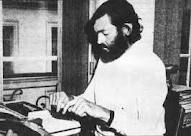
Julio Cortázar

I recently stumbled upon an excellent interview on one of the greatest Latin American authors, Julio Cortázar.

For those that haven't read his works, I highly recommend him. He is a master at writing short stories as well as longer works of literature.

Here is an excerpt form the interview:

INTERVIEWER
You have said at various times that, for you, literature is like a game. In what ways?

CORTÁZAR
For me, literature is a form of play. But I’ve always added that there are two forms of play: football, for example, which is basically a game, and then games that are very profound and serious. When children play, though they’re amusing themselves, they take it very seriously. It’s important. It’s just as serious for them now as love will be ten years from now. I remember when I was little and my parents used to say, “Okay, you’ve played enough, come take a bath now.” I found that completely idiotic, because, for me, the bath was a silly matter. It had no importance whatsoever, while playing with my friends was something serious. Literature is like that—it’s a game, but it’s a game one can put one’s life into. One can do everything for that game.

INTERVIEWER
When did you become interested in the fantastic? Were you very young?

CORTÁZAR
It began in my childhood. Most of my young classmates had no sense of the fantastic. They took things as they were . . . this is a plant, that is an armchair. But for me, things were not that well defined. My mother, who’s still alive and is a very imaginative woman, encouraged me. Instead of saying, “No, no, you should be serious,” she was pleased that I was imaginative; when I turned towards the world of the fantastic, she helped by giving me books to read. I read Edgar Allan Poe for the first time when I was only nine. I stole the book to read because my mother didn’t want me to read it; she thought I was too young and she was right. The book scared me and I was ill for three months, because I believed in it . . . dur comme fer as the French say. For me, the fantastic was perfectly natural; I had no doubts at all. That’s the way things were. When I gave those kinds of books to my friends, they’d say, “But no, we prefer to read cowboy stories.” Cowboys were especially popular at the time. I didn’t understand that. I preferred the world of the supernatural, of the fantastic.

Alas, I am still working on finishing  the first book of the Tale of Genji. Désolé... There will be a post for that soon.
Follow the rabbit trail...